The thoracic sling plays a crucial yet often overlooked role in the horse’s movement & stability. As an equine massage therapists, we recognize the importance of the thoracic sling in maintaining overall musculoskeletal health and optimizing performance. In this month’s blog post, I will offer an insight into what the thoracic sling is, how it works, & its significance in equine health & massage therapy.
What is the Thoracic Sling?
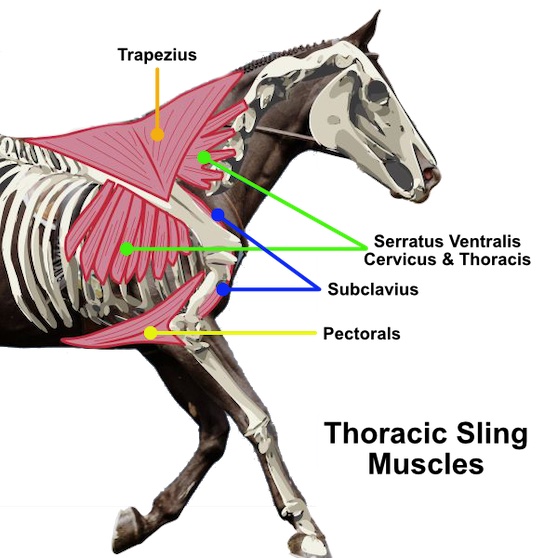
The thoracic sling is a complex arrangement of muscles, tendons, & connective tissues that suspend the horse’s torso between its forelimbs. Unlike humans and many other animals, horses do not have a clavicle (collarbone) which connects their forelimbs to the rest of their skeleton. Instead, their forelimbs are connected to the torso entirely by the thoracic sling.
The Thoracic Sling allows for the majority of the horse’s movement giving it the ability to move in multiple directions such as forward and turning, bending & jumping. Because of its function, ensuring a well conditioned & functioning Thoracic Sling is essential for a horse's overall body soundness & performance.
Key muscles of the thoracic sling include:
- Serratus Ventralis Muscles: Thoracic & Cervical Parts which are crucial for supporting the weight of the torso.
- Pectoral Muscles: Ascending, Descending & Transverse Parts. These aid in adduction and stabilization of the forelimbs.
- Subclavian Muscle: These aid in protraction and stabilization of the forelimbs.
- Trapezius muscles: These muscles assist in the elevation & positioning of the scapula.
How the Thoracic Sling works
The Thoracic Sling functions as a dynamic support system that allows for flexibility, shock absorption, and efficient movement. Here’s how it works:
Recognising The Signs of a Weak Thoracic Sling.
A weak Thoracic Sling can have a profound impact on your horse's entire body & the way in which it functions. It can cause poor gait, which can then lead to dysfunction within the limbs. The risk of lameness can also be increased.
Riding style, not enough free movement, and tense, consistent high head carriage will create dysfunction in the body and weakness in the thoracic sling.<br /><br />
Signs of a Weak Thoracic Sling May Include:
- Difficulty in Turning.
- Lack of Engagement and push from the hind end.
- Tendency to "Fall In" on corners/turns.
- Soreness through other areas of the body.
- Falling onto the forehand.
- Girthiness can also indicate soreness cause by a weak Thoracic Sling.
- Struggling to navigate hilly or uneven ground.
- Performance issues such a tiring more quickly during exercise.
- A reduction in flexibility.
- Shortening in length of stride.
- Cross cantering and/or difficulty in picking up the correct lead.
- Hollow posture when exercising.
- Poor balance.
Whilst the above could indicate a weak Thoracic Sling, they could also be related to other possible issues. See a Massage Therapist or consult your Veterinarian.
Exercises to Help Strengthen the Thoracic Sling:
1. Pole Work
Pole work is fantastic for improving the thoracic sling. It can be done in hand during the early stages of rehabilitation and increase in complexity as there are improvements and you move to ridden work.
2. Raised cavaletti work
Setting up raised cavaletti encourages the horse to lift its legs and stretch its head down and out, engaging the thoracic sling muscles.
3. Hill work
Riding the horse uphill prompts the engagement of the thoracic sling. This does not need to be fast work to get results. Plenty of slow work in hand and undersaddle at the walk will slowly build the thoracic sling
4. Backing up
Backing up a few times in hand on a daily basis encourages the horse to use its thoracic sling muscles more correctly. The horse should be allowed/encouraged to lower its head during this exercise, or they will hollow. A raised head also inhibits their ability to step backwards.
3. Lateral Work
Incorporating lateral exercises such as leg-yields and shoulder-in when the horse is ready can further strengthen the thoracic sling and connected muscles.
Taking time to work through beneficial exercises, such as above will help the horse develop correct muscle function, better posture and reduce wear on the anatomy of the lower limbs.
Finally
Understanding and addressing the importance of the thoracic sling in a horse's musculature is essential for promoting optimal performance and preventing injuries. Regular, targeted exercises can contribute to the development of a strong and resilient thoracic sling, ensuring a horse's overall well-being.
Illustrations by Alexa McKenna BVM & S from the book Horse Movement, Structure, Function and Rehabilitation by Gail Williams PhD